Conveyor Technology in the Building Materials Sector: What Systems for Bulk Materials and Minerals Really Have to Withstand
Published on May 26, 2026
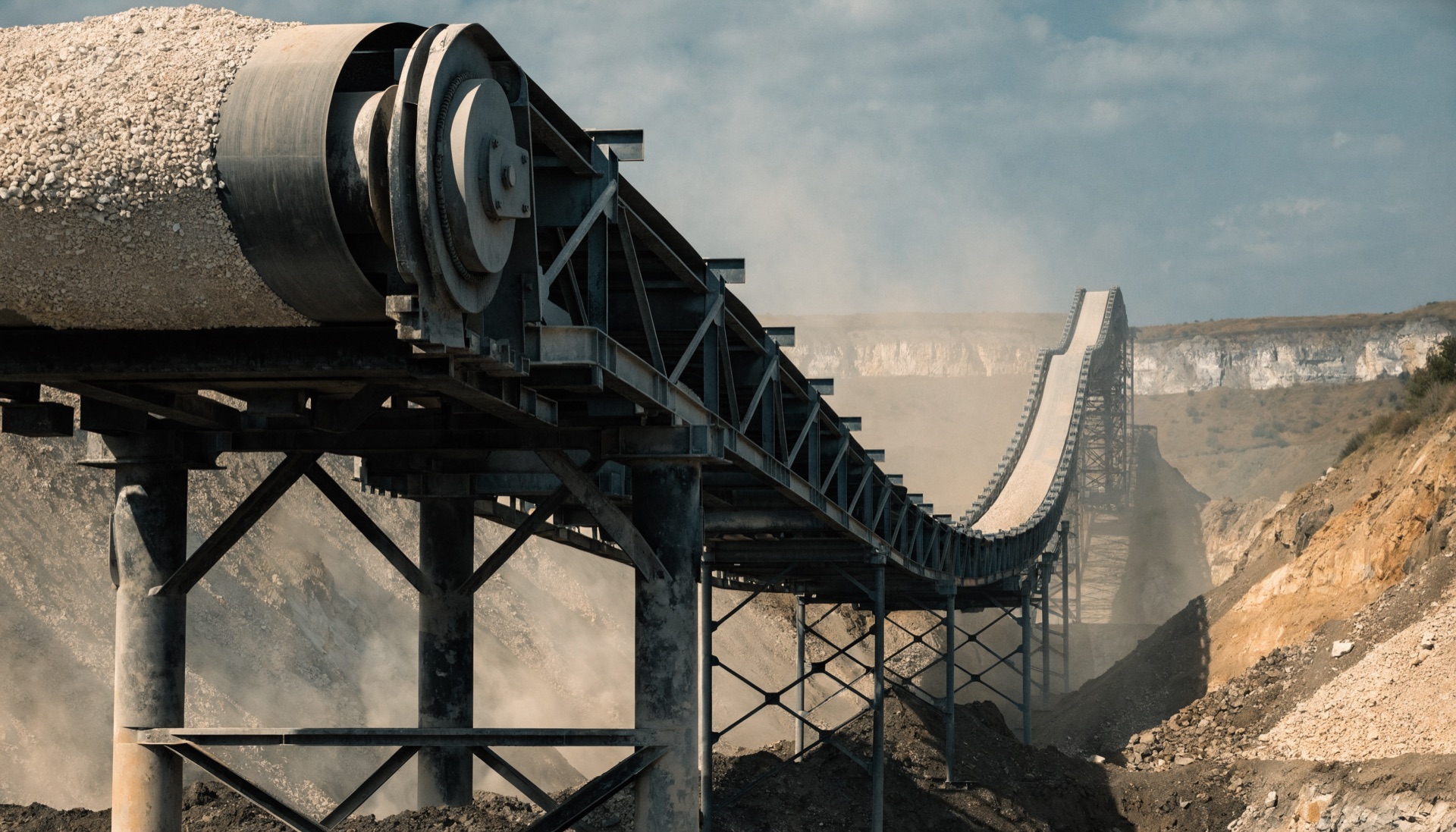
Conveyor technology in the building materials industry is a world of its own. What runs through belt systems, bucket elevators and chutes here has properties that occur in no other industry in this combination: high dead weight, sharp-edged geometry, abrasive effect, often moisture, sometimes temperature. A conveyor system that is not designed for exactly these conditions wears out in a fraction of its expected service life. In this article we summarise what matters in conveyor technology for bulk materials and minerals and which design decisions determine the service life of a system.
Bulk material is not just bulk material
Before anything is designed, the material properties of the conveyed product have to be clear. We talk to customers early about the decisive parameters.
Particle size distribution. How large are the pieces, what is the distribution? Pure fine grain behaves differently from mixtures with pieces up to 200 millimetres. Maximum particle size is not the only criterion; often the fractions in between are more decisive for the design.
Bulk density. How heavy is a bulk load? Sandstone and granite have very different densities. From this follow belt loads, drive power and strength requirements for the structure.
Abrasiveness. Mineral hardness (often according to Mohs) and the angularity of the grains determine how strongly a system wears. Quartz-containing materials are particularly aggressive.
Moisture and stickiness. Wet materials tend to cake, especially in the fine fractions. What sticks, clogs. Hoppers, transfer points and cleaning points have to respond to this.
Temperature. Calcined minerals can still arrive hot, which puts strain on belt coverings, bearings and control elements.
Tendency to clump and cake. Some bulk materials lodge in transfer points and only break loose again when the system stops. Such materials demand special design attention.
The design of a conveyor system therefore does not begin with a data sheet, but with the material conversation.
Belt conveyor, chain conveyor, bucket elevator or screw conveyor
Which type of conveyor is the right one depends on the material, the distance, the conveying height and the application environment.
Belt conveyors are the classic choice for horizontal and slightly inclined conveying paths with large quantities. They are robust, their maintenance is manageable and their energy efficiency is good. With highly abrasive material and large pieces, they need special belt coverings or steel-plate belts. Steep inclines up to 18 degrees are possible with standard belts, beyond that with profiled belts or bucket belts.
Chain conveyors (en-masse drag chain conveyors) are suitable for dust-tight conveying of fine, often hot or sticky materials. We frequently build them for cement and lime applications.
Bucket elevators are the first choice for vertical conveying over large heights, for example when feeding silos. They offer high conveying capacity per footprint, but are more demanding in design terms (bucket fastening, drive, maintenance access).
Screw conveyors transport powder and fine minerals over short to medium distances. They are compact, can be made dust-tight well and are inexpensive to purchase. With abrasive material, however, they wear relatively quickly; the material of the screws and trough linings is decisive.
Materials and wear protection: the decisive lever
Wear is the number one cost driver in the building materials sector. A poor choice of material can reduce a system from a planned service life of ten years to three. Depending on the application, we rely on different solutions.
High-strength steels such as HARDOX or XAR with hardnesses from 400 to 500 HBW as the standard for heavily stressed surfaces. They combine wear resistance with weldability, which makes them easy to work with in our workshop.
Special linings of ceramic, polyurethane or rubber for heavily loaded transfer points, chutes and slides. Ceramic tiles are expensive but unbeatable with fine, aggressive grain. Polyurethane combines wear resistance with damping.
Replaceable wear plates at wear-critical points. We design things so that the stressed plates can be swapped without major disassembly. This shortens maintenance downtime and makes the system economical to operate.
Manganese steel liner plates for very heavy materials with coarse grain, because manganese steel work-hardens under pressure load and thus develops a self-reinforcing wear layer.
The right choice of material is never a standard decision. We weigh purchase price against service life, maintenance effort against downtime costs, and decide together with the customer.
Dust, noise, safety: what comes on top in the building materials environment
Building-materials conveyor technology does not operate in a clean factory hall, but often in the quarry, outdoors, in rough everyday industrial conditions. Three topics are constant companions.
Dust. Bulk materials release dust, which is not only a hygiene risk but also a health and safety risk (silicosis, ATEX). We consistently plan conveyor technology with dust protection: encapsulated transfer points, extraction systems, water misting where it makes sense.
Noise. Conveyor systems in quarries are loud. Noise protection begins with the design (damped drives, vibration decoupling, sound insulation) and not only with hearing protection for employees.
Safety. Belt conveyors are accident-prone systems. Emergency stop via pull-wire switches, nip-point guarding, maintenance platforms, safe cleaning options: safety is built in by design, not patched on later.
When it is worth giving us a call
We are the right partner if you are planning a new conveyor system for building materials, minerals or bulk goods that is more than a standard conveyor from a catalogue. We are the right partner if your existing system wears too quickly, stops too often or does not let the material through reliably. And we are the right partner if, for a new plant or a plant expansion, you are looking for a partner who designs, manufactures and commissions systems, who uses high-quality materials and who does not vanish after commissioning.
By location we are in Niederstotzingen in Baden-Württemberg, with the Bavarian region, the Swabian region and southern Germany in our direct catchment area. But we deliver and assemble systems wherever the project takes us.
If you have a concrete project ahead of you, get in touch. First we go through the material and the requirements, then we talk about solutions.
Do you have a concrete project?
Talk to our engineering team. An initial conversation is non-binding and quickly creates clarity.