Stainless Steel Special-Purpose Machinery for the Food Industry: What Really Matters in Design and Manufacturing
Published on May 26, 2026
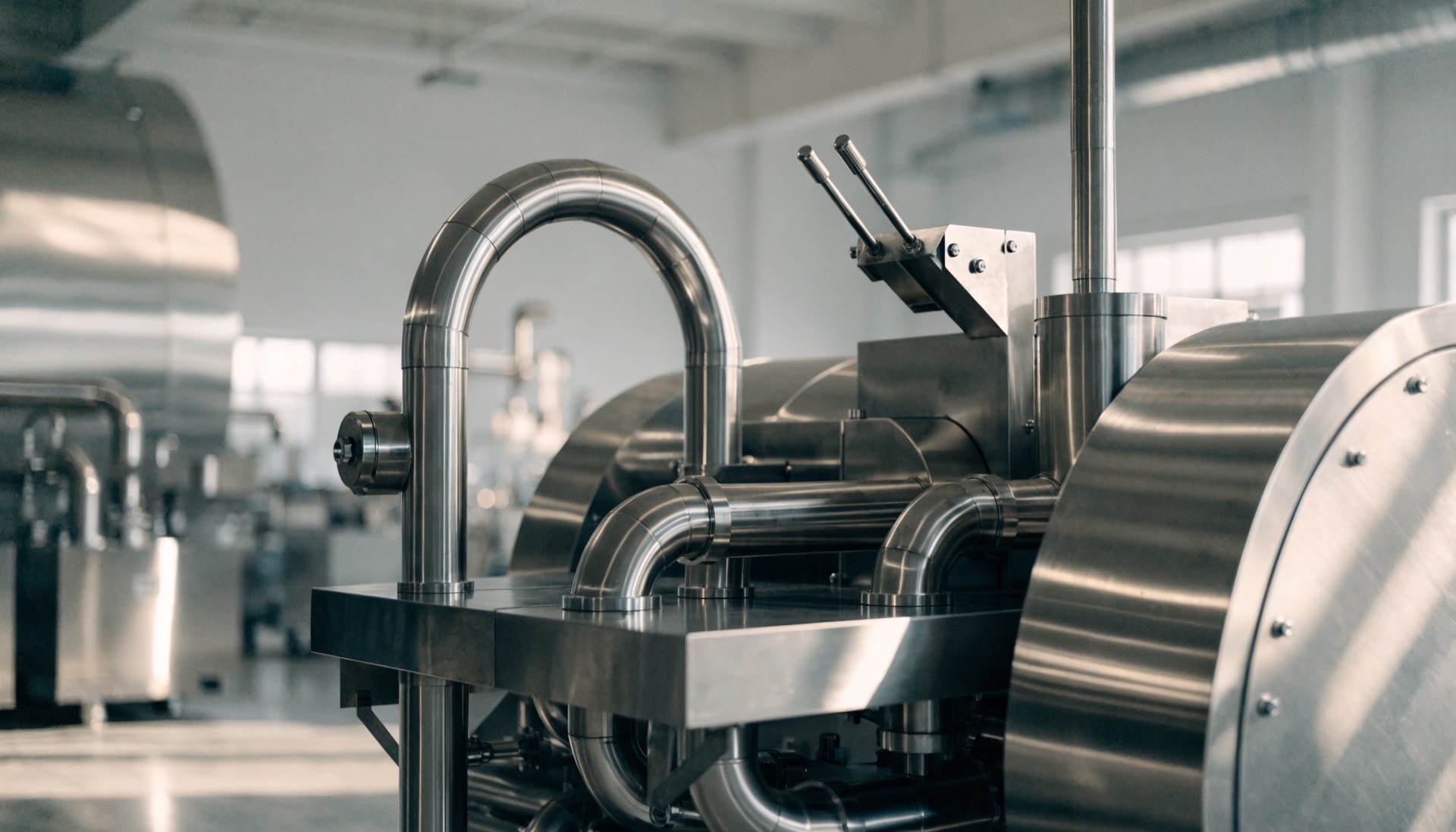
A special-purpose machine for the food industry is more than a modified standard system. It has to be cleanable, it has to produce free of contamination, it has to withstand thousands of cleaning cycles with aggressive agents, and it has to fit into an existing production line. Any manufacturer who has ever worked with a system that was not designed for these requirements knows that it quickly becomes about far more than just material. It is about downtime, hygiene audits and, ultimately, the marketability of the products themselves.
We have been building special-purpose machines for more than 30 years, a large share of them for the food industry. In this article we summarise what really matters in stainless steel design and manufacturing, and which questions need to be clarified early in a plant project.
Why stainless steel is not just stainless steel
In plant engineering for the food industry, stainless steel is the standard material. But "stainless steel" is only an umbrella term. In practice, the material number, surface finish and welds determine whether a system runs flawlessly for ten years or shows pitting corrosion in its third year.
For product-contact areas we generally use austenitic chromium-nickel steel 1.4301 or, when aggressive cleaning agents or chlorides are involved, molybdenum-alloyed 1.4404. For applications with particularly high corrosion exposure, for example in cheese or sausage production, duplex steel can also be the right choice. Which material makes sense cannot be decided from a catalogue; it depends on the product, the cleaning concept and the expected service life.
At least as important as the material number is the surface finish. A ground surface with an Ra value below 0.8 µm is considered the standard for product-contact surfaces in hygienic design. In very sensitive applications, such as sterile areas, we move to electropolished surfaces with Ra below 0.4 µm. Smooth surfaces offer fewer points for microorganisms to adhere to and are significantly easier to clean.
Hygienic design is engineering, not cosmetics
Hygienic design is often confused with "shiny stainless steel". In reality it is a consistent design philosophy. Every corner, every bolted joint, every bearing point is planned so that no product residues or cleaning media can settle and so that all surfaces can be cleaned without disassembly.
In practical terms this means: no horizontal surfaces without sufficient slope, no edges with a radius below three millimetres, no dead spaces in piping, no bolted connections in the product area wherever they can be avoided. Welds are ground and passivated, not simply welded. Where connecting elements are unavoidable, they are chosen in a hygienic design, for example as crevice-free weld-on connectors or Tri-Clamp connections.
Anyone who builds a system that does not consistently meet these design rules has an open flank in every audit. That is not only a hygiene risk, but an economic one as well.
EHEDG, FDA, 3-A: when each one counts
Various standards and guidelines come up in the food industry. Depending on the application, we are guided by different standards.
EHEDG (European Hygienic Engineering and Design Group) is the European standard for hygienic design. The EHEDG guidelines cover components, plant sections and entire production lines. Where possible, we use EHEDG-certified components and build systems so that they are EHEDG-compliant.
FDA conformity concerns materials that come into contact with food and is mainly relevant when the system is exported to the USA or when customers place value on FDA-compliant seals, hoses and plastics.
3-A Sanitary Standards originate in the USA and apply above all in dairy processing. When a customer requires 3-A, very specific requirements for design and materials must be met.
Which standard is relevant is something we clarify early in the project. It makes a considerable difference whether a system is "built according to EHEDG principles" or "EHEDG-certified". Both have their place, but it has to be communicated clearly.
Cleanability: CIP, COP and manual cleaning
A food producer stops the line regularly for cleaning. How this cleaning works determines the productive availability of the system. We design special-purpose machines so that the customer's cleaning concept is technically feasible and does not become a bottleneck in day-to-day operation.
Cleaning in Place (CIP) refers to automated cleaning without disassembly. The system is flushed with cleaning solutions, often in several stages with alkali, acid and disinfection. CIP capability has to be considered from the very first design sketch, otherwise dead spaces arise that undermine the procedure.
Cleaning out of Place (COP) is cleaning in a separate cleaning unit, often for components that cannot be cleaned within the running assembly. Here, disassembly must be possible with few tools and components must be supported accordingly.
Manual cleaning is still a reality in many systems. We take this into account in the design as well: accessible surfaces, ergonomic cleaning points, no geometries that can only be reached with gymnastic contortions.
Design, manufacturing and commissioning from a single source
What distinguishes us as a family-run engineering company is the value chain under one roof. Designer, welder, fitter and commissioning engineer all work at the same site in Niederstotzingen. In special-purpose machinery for the food industry, this has two concrete advantages.
First, design and manufacturing knowledge are tightly linked. A weld in hygienic design is different from a normal steel-construction weld. Our design office knows what our welders can produce and under which conditions this works hygienically. Design decisions that would cause problems in the workshop never get made in the first place.
Second, commissioning runs more smoothly. When the fitter on site has to readjust a detail, the answer from Niederstotzingen is available directly, without several supplier and subcontractor levels in between. For food lines, where every hour of downtime is expensive, this is a hard economic advantage.
When it is worth giving us a call
We are the right partner if you need a special-purpose machine or a complete system for your food production that does not come from a catalogue. We are the right partner if you want to modernise an existing system because it is no longer state of the art in hygiene terms or because cleaning takes too long. And we are the right partner if you are looking for a company that delivers design, manufacturing and commissioning from a single source.
If you already have a concrete project in mind or first want to have technical conversations, get in touch. An initial discussion with our engineering team costs nothing and quickly creates clarity about whether we are the right partner for your project.
Do you have a concrete project?
Talk to our engineering team. An initial conversation is non-binding and quickly creates clarity.