Design for welding: what makes a welded structure fit for production
Published on October 13, 2026
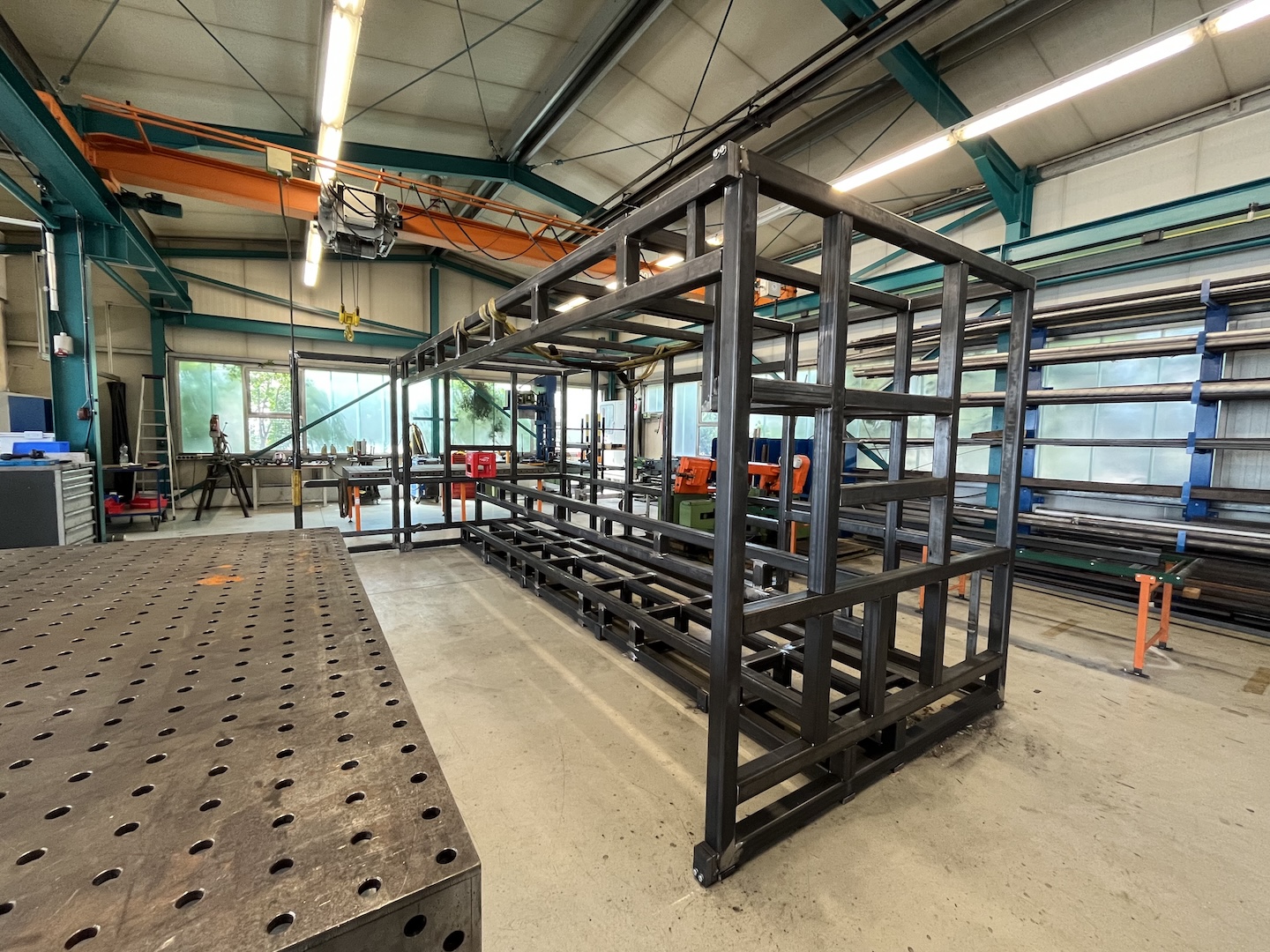
A welded structure joins sheets, profiles or tubes by weld seams into a load-bearing component. Whether it can be produced accurately and at reasonable cost is decided mostly in the design, not at the welding station. This article sums up the points that make the difference in practice.
When a welded structure is the right choice
Frames, stands, brackets and machine bases are often welded. Compared with casting or machining from solid, this pays off above all for large dimensions, one-offs and small batches, and wherever the design may still change. A casting mould only pays off over volume; a welded structure can be adapted from part to part.
Weld accessibility
Every seam on the drawing must actually be reachable by the welder. The torch needs space and a sensible working angle. Internal seams, tight corners and seams that could only be welded after another part has been fitted are typical pitfalls. It helps to think through, while designing, the order in which the parts will be assembled and welded.
Heat, shrinkage and distortion
Welding introduces heat, and the seam shrinks as it cools. That pulls the component out of shape. The more weld volume, the more distortion. Hence: do not size seams larger than strength requires, arrange seams as symmetrically as possible and avoid weld accumulations, for example where several seams cross at one point.
Functional surfaces with tight tolerances, such as bearing seats or mounting faces, are usually machined after welding. Planning for this from the start and allowing machining stock avoids rework. For series parts, a welding fixture holds the individual parts in position and keeps distortion consistent from part to part.
Joint preparation and tolerances
Joint type and groove shape belong clearly on the drawing: fillet weld or butt weld, which throat thickness, which edge preparation. For dimensional tolerances, DIN EN ISO 13920 provides general tolerances specifically for welded structures. Tighter tolerances are possible but cost effort. They belong where the function requires them, not across the whole component.
Steel or stainless steel
Structural steel welds well and is inexpensive. Stainless steel is chosen where corrosion or hygiene require it, for example in the food industry. It expands more with heat than structural steel and distorts correspondingly more. After welding, heat tint has to be removed so that corrosion resistance is retained. In hygiene-sensitive areas, smooth, crevice-free seams are needed as well.
Welding processes
Two processes are most common in steel and mechanical engineering. MAG welding is fast and economical and the usual choice for structural steel. TIG welding is slower but produces clean, controlled seams and suits stainless steel, thin sheets and visible seams. Stick welding complements both, for example in hard-to-reach places. Tomasic welds steel and stainless steel assemblies using all three processes.
Execution class to EN 1090
If the component is a load-bearing steel component, the designer specifies an execution class to EN 1090, from EXC1 to EXC4. It determines the requirements for manufacturing, testing and documentation. The class belongs on the drawing or in the enquiry, because the manufacturer has to be certified for it. Tomasic is certified to EN 1090 in execution class EXC2.
What belongs in the drawing and enquiry
A welded structure can be quoted reliably once the material, weld details with joint type and throat thickness, the tolerance class, the execution class if applicable, the quantity, the required surface treatment and any testing requirements are fixed. At Tomasic, design and welding production take place in-house; surface treatment is handled by partner companies.
Do you have a concrete project?
Talk to our engineering team. An initial conversation is non-binding and quickly creates clarity.