Automatic layer-by-layer stacking of products onto pallets, from a robot gripper to full automation.
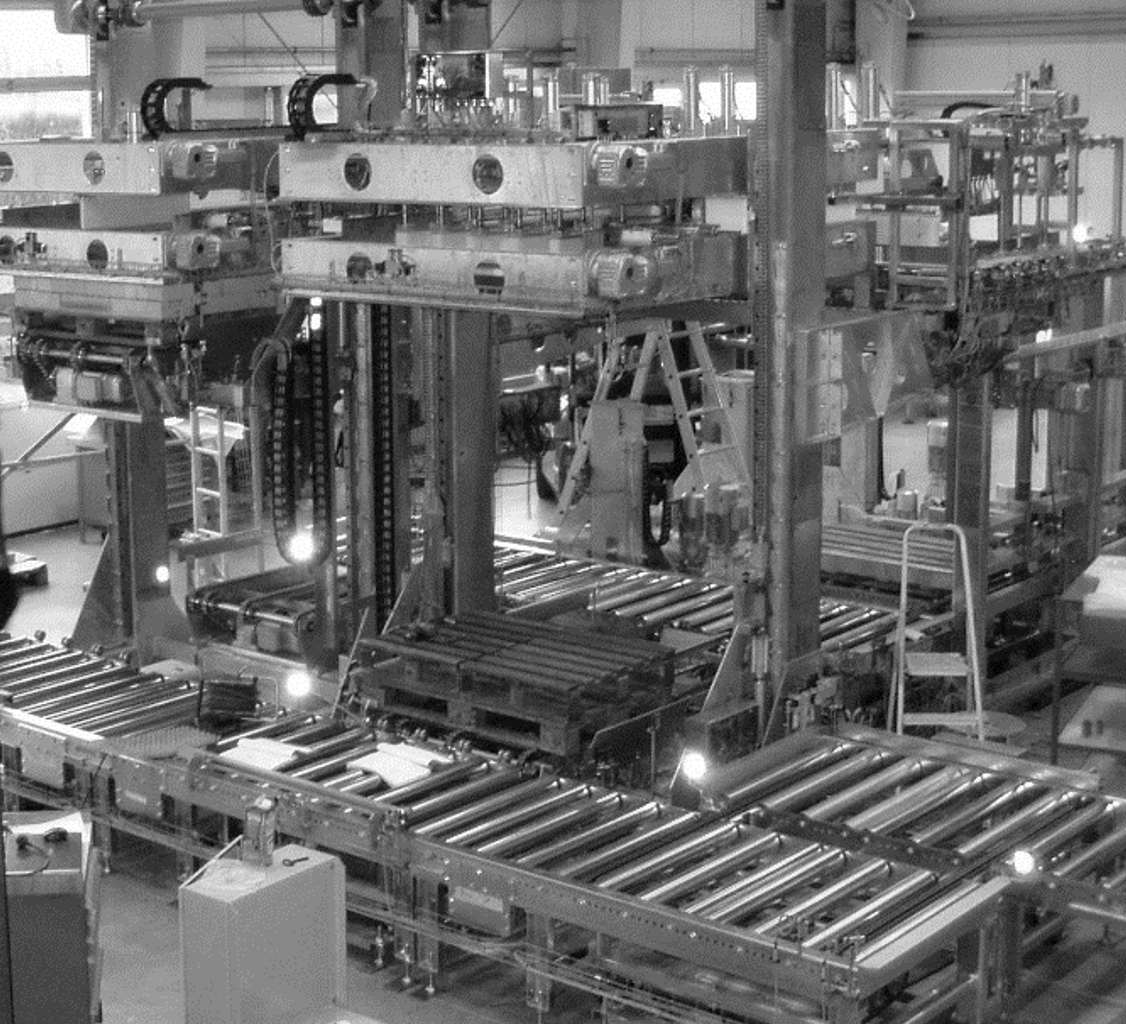
Palletising systems are used wherever cartons, sacks, containers or individual products need to be made ready for shipping in large quantities — in food production, the building-materials industry, consumer goods manufacturing and logistics. They replace manual stacking, which is physically demanding and error-prone at high cycle rates and with heavy products.
Depending on the product range, palletising systems can be designed for a single product line or for varying products with different pallet patterns.
The simplest configuration is robotic palletising: a palletising robot picks cartons or containers and places them onto the pallet in a defined pattern — flexible, space-saving, and suitable even for smaller and medium cycle rates.
For high throughput, we build fully automated lines with a layer former that places entire product layers onto the pallet at once, and add a stretch wrapper on request that automatically secures the finished pallet with film — from singulation to a ready-to-ship pallet, all from a single source.
We design palletising solutions to match product weight, packaging type and required cycle output, and integrate them seamlessly into existing filling and packaging lines. The system is tailored to your specific product range and can be extended with layer forming, shrink-wrapping or lid-application as needed — for a continuous, automated packaging solution at the end of your production line.
The cost of a palletising system depends heavily on cycle rate, product range and level of automation — a simple robotic palletising setup is significantly cheaper than a fully automated line with a layer former and stretch wrapper. After a design consultation, we prepare an individual quote tailored exactly to your requirements.
Automatic palletising becomes worthwhile once manual stacking becomes a bottleneck or the physical strain on staff is too high — often from several hundred containers per shift upwards. Based on your current cycle times and product weights, we assess the point at which an investment pays off.
Yes, modern palletising systems can be designed for multiple product variants and pallet patterns and switched between them via a program change. How much flexibility makes sense depends on the number and similarity of your product variants — we clarify this during plant planning.
Yes, palletising systems can generally be integrated at the end of an existing filling or packaging line, provided transfer points and cycle times are coordinated. We assess on site how the new system can connect to your existing line and adapt the design accordingly.