Gentle, reliable transport of unit loads, bulk goods and sensitive products over short and long distances.
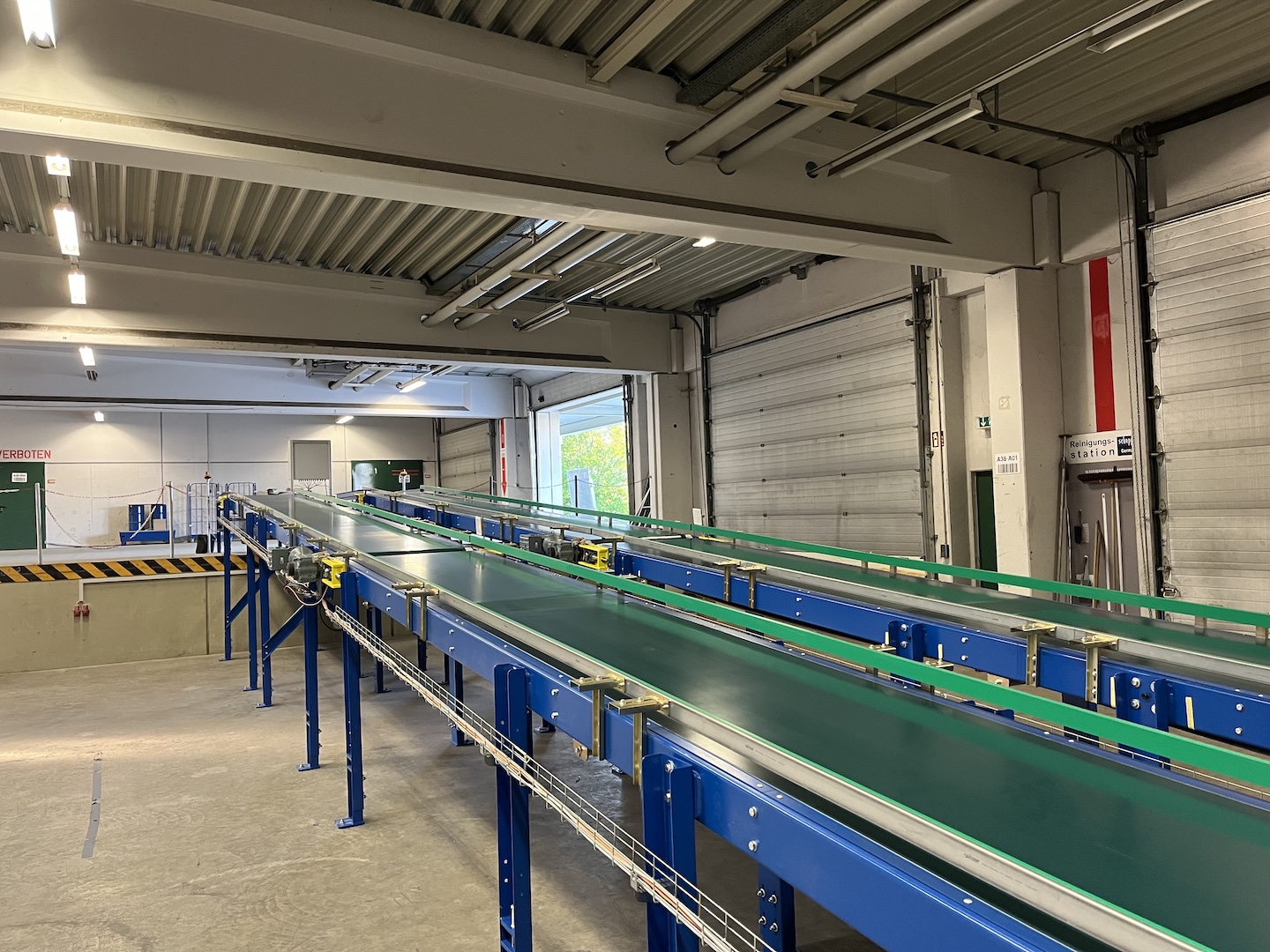
Belt conveyors transport both unit loads such as cartons and components and bulk goods such as granulate or shavings — horizontally, inclined, or combined with other conveying technologies. They are used wherever products need to move gently and without damage, for example in food processing, packaging technology or metalworking.
Their large support surface makes them particularly suited to products that would tip, slide or fall through on a roller conveyor — from loose bulk material to irregularly shaped parts.
For the food and dairy industry, we supply belt conveyors with food-safe, easy-to-clean belt materials and stainless-steel frames that meet the hygiene requirements of these sectors. For metal or wood processing, more robust, abrasion-resistant belt materials are used instead.
We match incline, belt width, side guides and drive power to the conveying speed, gradient and weight of the respective product — from a short transfer belt to a long conveying section between two production areas.
We design belt conveyors individually rather than from a catalogue: belt width, incline, load capacity and the hygiene requirements of your industry feed directly into the design. Whether as a single transfer section or the core element of a fully automated production line, we design, build and integrate the belt conveyor to fit your existing plant concept.
For the food and dairy industry, we use food-safe, easy-to-clean belt materials combined with stainless-steel frames. The exact material depends on the product, your cleaning routine and the hygiene requirements of your facility — we clarify this individually during the design consultation.
The maximum incline depends on the product and the belt surface: smooth products on a smooth belt tolerate significantly less incline than rough bulk material on a profiled belt. Where needed, we use profiled or cleated belts to ensure safe transport even on steeper conveying sections.
A belt conveyor can generally be designed for both, but belt surface and side guides determine how well it suits each type of goods. For mixed operation, we work with you to determine which belt design and side containment meets both requirements.
Belt conveyors can be built from short transfer sections under one metre up to several tens of metres in length, with multiple drive and return stations if needed. The exact section length depends on your plant layout and is determined during on-site planning.