Energy-efficient, low-maintenance transport of pallets, boxes and unit loads – driven or as a gravity conveyor.
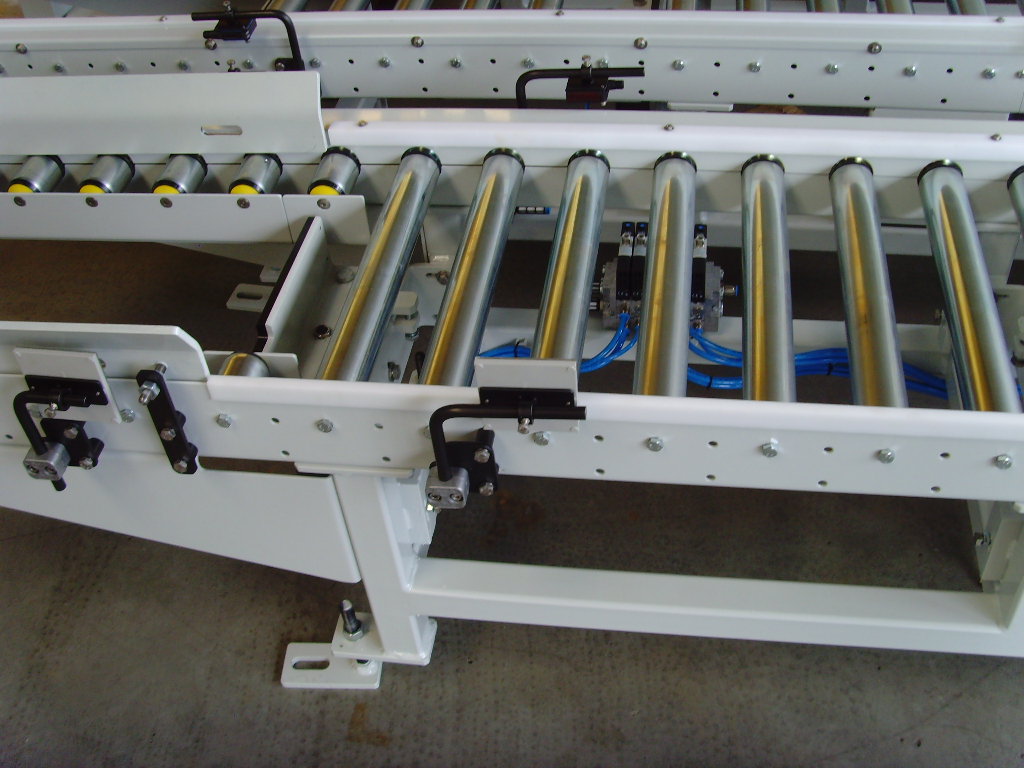
Roller conveyors connect processing stations, storage and shipping areas in almost any industry that moves palletised or boxed goods – from food production to building materials, automotive supply and logistics centres. Wherever unit loads need to travel from A to B in a consistent orientation, a roller conveyor is the natural choice.
They are also widely used to link individual machines or inspection stations within a production line: bridging distances, buffering goods briefly, and combining with switches, turning stations or singulation units into a continuous conveying line.
Powered roller conveyors move goods via a motor and are suited to cycle-controlled, regulated material flow – for example when goods need to stop at a defined position or move on at a set speed. Power is transmitted via roller chains, toothed belts or drum motors, depending on requirements.
Gravity conveyors need no drive of their own: the incline alone moves the goods. They are particularly low-maintenance, cost-effective to procure, and well suited to buffer sections and manual or semi-automated material flow, such as in order picking.
As a special-machine builder with experience since 1994, we don't supply roller conveyors off the shelf — we dimension rollers, frame and drive unit to match the load weight, cycle time and environmental conditions of your plant. Whether as a standalone conveying section or integrated into a fully automated line, we design, build and commission the roller conveyor on site.
The load capacity of a roller conveyor depends on roller diameter, roller spacing and frame construction, and is dimensioned individually for the goods being conveyed. We size every roller conveyor based on the weight, size and volume of your products so it runs reliably in continuous operation.
A powered roller conveyor actively moves goods via a motor, enabling cycle-controlled, regulated material flow. A gravity conveyor has no drive of its own and relies solely on the incline of the conveyor — it is simpler in construction but depends on sufficient height difference.
Yes, roller conveyors can generally be integrated well into existing conveying lines, provided transfer points and connection heights are coordinated. We assess on site how the new roller conveyor can connect to your existing plant and adapt the design accordingly.
Very small, unstable or loose items without a stable footprint are only conditionally suitable for standard roller conveyors, as are sensitive products without stable packaging. In such cases, a belt conveyor or a combination of both conveying technologies is usually the better choice — we advise individually on this.