Special machines and systems in stainless steel, designed for thousands of cleaning cycles rather than for the brochure.
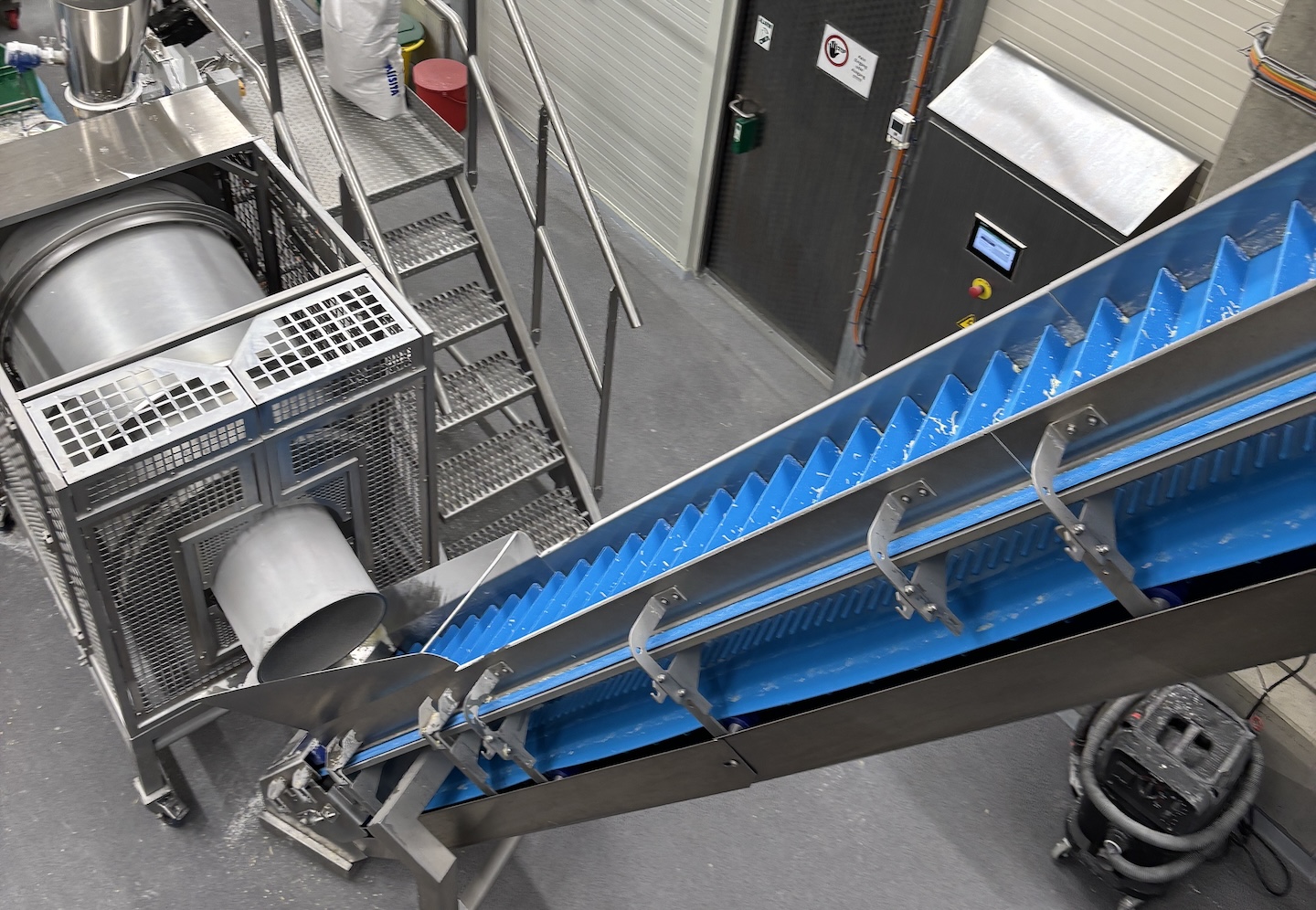
Stainless steel is the standard material in food plant engineering, but the term is only a collective one. In practice, material number, surface finish and welds decide whether a system runs trouble-free for ten years.
For product-contact areas we generally use the austenitic chromium-nickel steel 1.4301 or, where aggressive cleaning agents or chlorides are involved, the molybdenum-alloyed 1.4404.
Surface finish matters at least as much. A ground surface with an Ra value below 0.8 micrometres is the hygienic design standard for product-contact surfaces; in very sensitive applications we go below that.
Hygienic design is often confused with shiny stainless steel. It is in fact a consistent design rule: every corner, every bolted joint and every bearing point is planned so that no product residue or cleaning medium can settle.
In practice that means no horizontal surfaces without sufficient fall, no edges with a radius below three millimetres, no dead spaces in pipework and no bolted connections in the product area where they can be avoided.
A system that does not meet these rules throughout has an open flank in every audit. That is not only a hygiene risk but an economic one.
EHEDG is the European standard for hygienic design and covers components, system parts and entire production lines. Where possible, we use EHEDG-certified components.
FDA conformity concerns the materials themselves and becomes relevant as soon as you ship to the USA or produce for a customer with US exposure. 3-A comes from American dairy technology and mainly appears with milk processing systems.
Which of these requirements actually applies depends on the product and the market, not on the machine. That is why we clarify it early rather than during design.
From special machinery come cheese grating systems, container emptying and separating stations. From conveyor technology come modular belt chains with stainless steel or plastic links that can be cleaned, plus roller and chain conveyors for containers. At the end of the line stand palletising, shrink wrapping and lidding.
Because design, steel construction, assembly and commissioning are in house, material choice and welding do not run through a supply chain. Surface treatment is the exception: finishing and galvanising go to partner companies.
Generally 1.4301, and with aggressive cleaning agents or chlorides the molybdenum-alloyed 1.4404. Which material fits depends on the product, the cleaning regime and the environment. We clarify this before design, because a material decision can only be corrected later at considerable cost.
We follow the EHEDG guidelines and use EHEDG-certified components where possible. Certifying a complete system is a separate process with EHEDG itself and is decided per project. For the manufacture of steel structures and welded assemblies we are certified to EN 1090, execution class EXC2.
An Ra value below 0.8 micrometres is the hygienic design standard for product-contact surfaces. In very sensitive applications, such as sterile areas, we go below that. What matters is not only the value but that it is held across welds and transitions.
Yes, provided transfer points, cycle times and cleaning regimes are matched. In practice the transfer between the old and the new system is the critical point, not the new system itself. We assess this on site and design accordingly.