Choosing the right conveyor type: designs, limits, transfer points
Published on September 13, 2026
The choice of conveyor type rarely comes down to the material alone. It comes down to incline, accumulation and cleanability, and it is settled for good at the points where two designs meet. This overview sorts the common designs and names the constraints that overturn a selection in practice.
The first cut runs between continuous and discontinuous conveyors. Continuous conveyors move material in a steady flow and serve a fixed route between two points. Discontinuous ones such as forklifts, cranes or automated guided vehicles pick up individual loads, deliver them and return empty.
Fixed route or forklift: the first cost question
The distinction is not a matter of definition but of cost. A continuous conveyor pays off when the same route is served often enough that the fixed installation is cheaper than repeated individual trips. In return it fixes the route: what it connects is set, and changing the layout means rebuilding.
Discontinuous conveyors are flexible but more expensive per unit moved, because every trip ties up staff or control and the return runs empty. In most plants the two work together: continuous conveyors in the cycled core process, discontinuous ones for infeed, removal and everything irregular.
Types with a traction element
Belt conveyors carry material on a revolving belt. They are the cheapest solution for uniform unit and bulk material on straight runs and they run quietly. Their limits are heat, sharp edges and high individual loads.
Chain conveyors transmit force through one or more chains. They take high loads, tolerate rough environments and position precisely via flights. In return they are louder and need more maintenance.
Bucket elevators and drag chain conveyors are the types for bulk material with a height difference. Bucket elevators lift vertically, drag chain conveyors pull the material through an enclosed, dust-tight trough, including on an incline.
Overhead monorails and circular conveyors suspend the load from a rail. They free up floor space and suit long, branched routes, for example in paint lines.
Types without a traction element
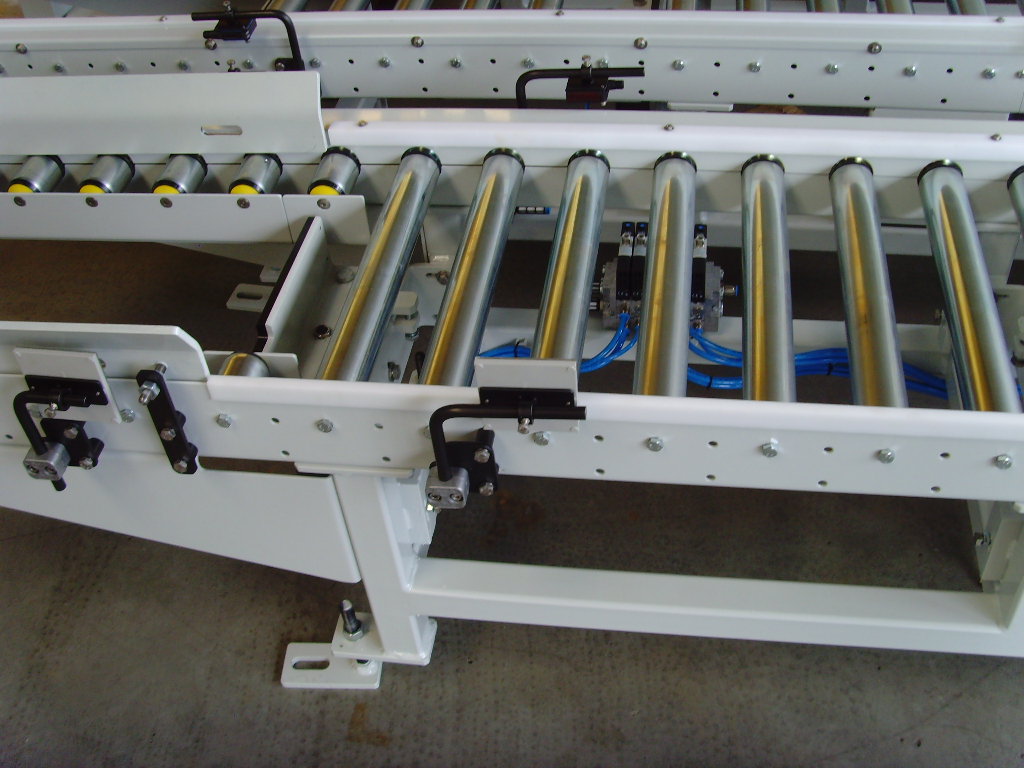
Roller conveyors move unit loads on a row of rollers. As a gravity conveyor they need no drive, only a slope; driven, they allow accumulation and zone control. The type requires a sufficiently rigid, flat contact surface on the load.
Screw conveyors push bulk material through a tube or trough with a rotating helix. They are compact, enclosed and capable of dosing, but face considerable wear with abrasive material. Vibratory conveyors and pneumatic conveying cover the cases where material has to be moved gently or through closed pipework.
What the choice depends on
The first decision is the material. Unit and bulk material lead to entirely different types, and within unit material it matters whether the load has a rigid contact surface. A carton runs on a roller conveyor, a sack does not.
Then come weight, distance, incline and cycle time. Only together do they give the throughput from which width, speed and drive power follow. The environment determines material and design: hygiene requirements in food production, temperature near ovens, dust and abrasion in the building materials industry.
Where the choice tips in practice
Three constraints overturn a selection more often than anything else. The incline: from roughly 15 to 20 degrees material slides on a smooth belt, and you need flights, a profiled belt or a different type altogether.
Accumulation: if material has to be able to wait on the line, that must be planned from the start. Retrofitting accumulation usually means a new line, because drive, zoning and control all change.
And cleaning: in food production, cleanability co-determines the conveyor type rather than the other way round. Open stainless steel designs with modular belt chains win there against more compact but hard to reach types.
The transfers are the real subject
A conveying system rarely consists of one type. As soon as two types meet, a transfer point is created, and that is where most faults occur: height offset, gaps, differing speeds, lost alignment. Anyone planning a system should look at the transfers earlier than at the individual sections.
That is also why a conveying line planned as a whole differs from one assembled out of catalogue parts. Not in the individual sections, but in the places between them.
Do you have a concrete project?
Talk to our engineering team. An initial conversation is non-binding and quickly creates clarity.