A belt conveyor moves material on a revolving belt made of rubber, plastic or textile-reinforced fabric. Its closed contact surface makes it the first choice when products are delicate, irregularly shaped or so small that they would tip over or fall through on a roller conveyor.
How a belt conveyor is built
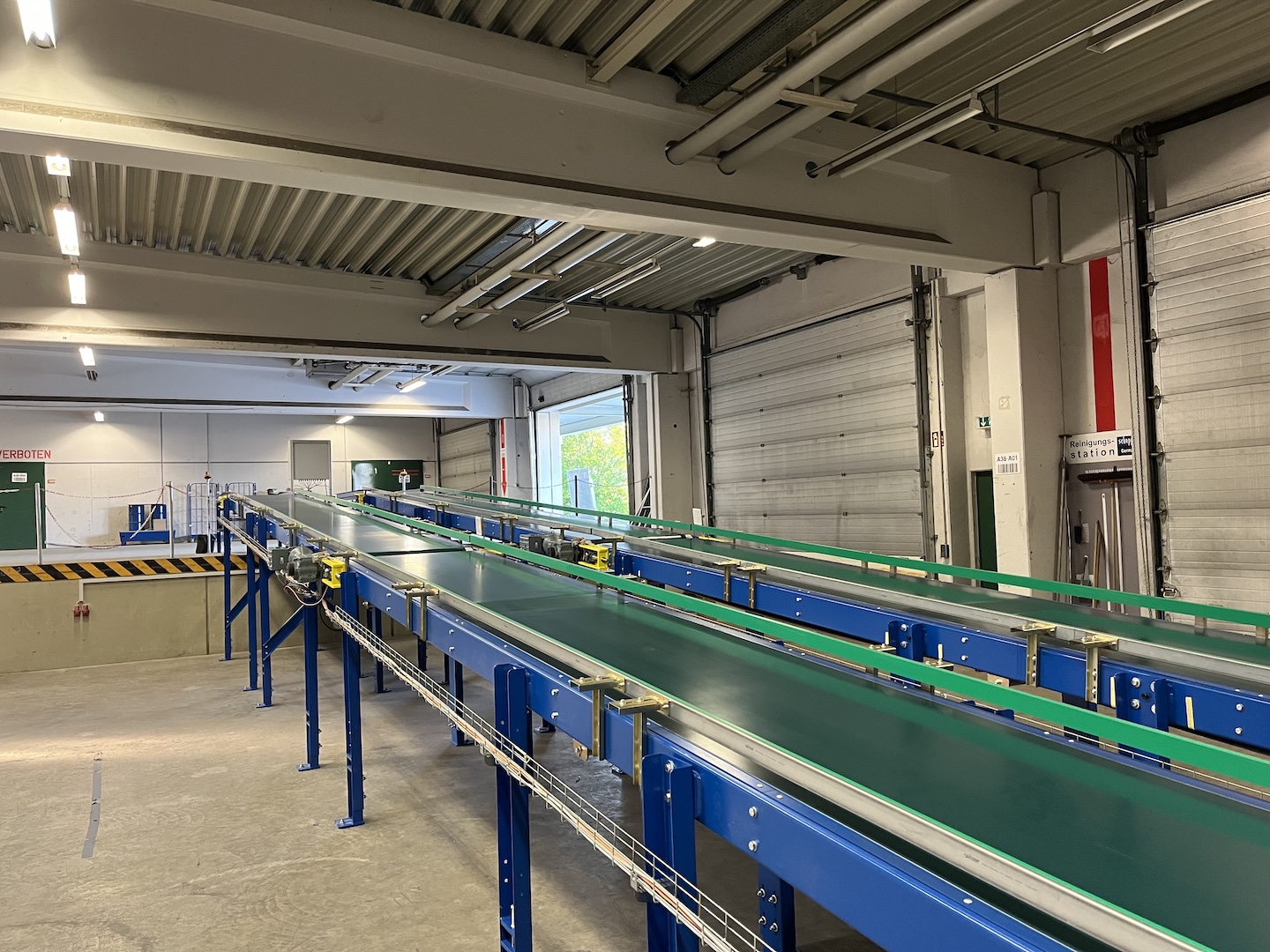
A frame of steel or aluminium profiles carries all assemblies; in food production it is made of stainless steel. At one end sits the drive drum with the geared motor, at the other the return drum. The belt runs endlessly around both drums, carrying on the upper strand and returning on the lower one.
On the upper strand the belt rests either on a continuous slider bed of sheet metal or plastic or on carrying idlers. A slider bed suits light unit loads and short runs; idlers reduce friction with heavy loads and long runs. A take-up station keeps the belt under tension and compensates for its elongation. To stop it running off to the side, the drums are slightly crowned or the belt has a guide profile on its underside.
Types
The flat belt conveyor is the basic form. It conveys horizontally or on a slight incline and moves unit loads such as cartons, components or packaged food.
In a troughed belt conveyor the side idlers are set at an angle so the belt forms a trough. This is the type for bulk material such as granulate or swarf, because the material stays in the trough and throughput rises for the same belt width.
For inclined runs a smooth belt only works up to a certain angle. Beyond that, profiled or ribbed belts are used, and on steep runs also cleats and corrugated sidewalls that hold the material in place. Finally, curved belt conveyors turn the material through 90 or 180 degrees without handing it over to a second conveyor.
Which belt material suits which job
The belt material depends on the conveyed product and the environment. For food, food-safe smooth plastic belts that are easy to clean are used. Bulk material, abrasive substances and harsh environments in metal or wood processing call for more robust, abrasion-resistant belts. The fabric plies inside determine how much tension the belt can take.
In hygiene-sensitive areas the whole construction matters, not just the belt: open frames without gaps where residues collect, stainless steel, and a belt that can be quickly slackened and removed for cleaning.
Advantages
Belt conveyors handle the material gently, because it lies flat and moves evenly. They run quietly, bridge short and long distances and also convey on an incline. Compared with a chain conveyor they need less maintenance, since there is nothing to lubricate, and infeed and transfer are simple to design.
Limits and drawbacks
Heat, sharp edges, weld spatter and oily swarf take their toll on a belt. Where such conditions prevail or very high individual loads such as pallets are moved, a chain or roller conveyor is usually the better choice. A torn belt is normally replaced in full, whereas a chain is repaired link by link.
Then there is positioning. Without flights or cleats, the position of the material on the belt is determined only by friction. For cycled stations that need an exact position this is too imprecise, and accumulation requires a belt with a suitable surface so the stationary material is not damaged.
What determines the sizing
The belt width follows from the largest item plus room for side guides, the speed from the required throughput. The tension needed is made up of the friction on the upper strand, the lifting force on inclines and the start-up. Drive power follows from tension and speed.
How steep a run may be depends on the pairing of belt and product. Smooth products on a smooth belt tolerate far less incline than rough bulk material on a profiled belt. Friction on the slider bed is regularly underestimated: on long runs with heavy unit loads it grows so much that carrying idlers become the more economical solution.
What belongs in an enquiry
A sizing that holds up needs the dimensions and weight of the material, whether unit loads or bulk material are conveyed, the conveying length and height difference, the required throughput and the ambient conditions such as temperature, moisture and dust. In food production the hygiene requirements and the cleaning routine belong in it too. Knowing the transfer heights of the adjoining stations as well saves a round of clarification.
Do you have a concrete project?
Talk to our engineering team. An initial conversation is non-binding and quickly creates clarity.