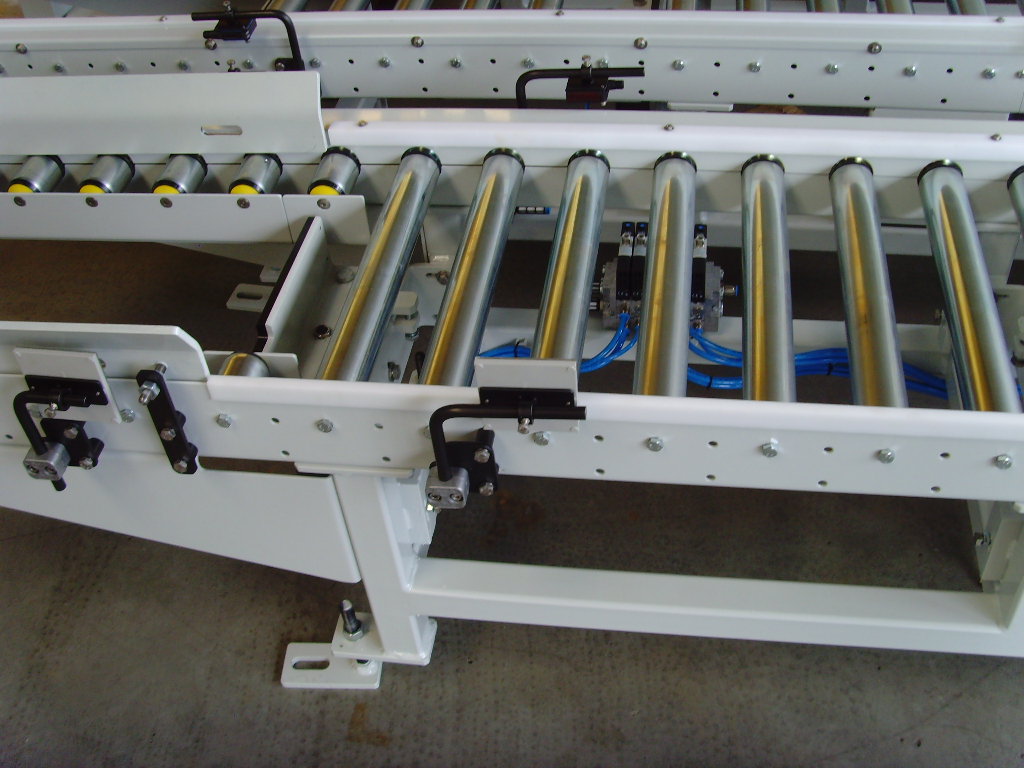
A roller conveyor transports unit loads on carrying rollers arranged one after another. It needs material with a load-bearing, flat underside: pallets, boxes, cartons or workpiece carriers. Depending on the type, the material is moved by gravity or by a drive.
How a roller conveyor is built
Two side profiles form the frame. Between them the carrying rollers sit on axles, supported by stands whose height can be matched to the transfer height of the adjoining stations. Three figures define a roller conveyor: the roller diameter, the distance between rollers, known as the roller pitch, and the roller material, usually galvanised steel, stainless steel or plastic.
The gravity roller conveyor
The gravity roller conveyor needs no drive of its own. It is installed with a slight decline and the material rolls by itself. That makes it low-maintenance and inexpensive to buy. Typical uses are buffer sections and manual or semi-automatic material flow, for example in order picking.
The right decline depends on the material. Light cartons stop if the incline is too shallow, heavy pallets pick up speed if it is too steep. With heavy loads, brake rollers that limit the speed belong in the line, and an end stop at the end.
The powered roller conveyor
A powered roller conveyor moves the material by motor. It is the choice when material flow needs to be cycled, when goods must stop at a defined position or continue at a defined speed.
There are three common ways to transmit power. With a roller chain drive the rollers are linked by sprockets. It transmits high forces and is the usual solution for pallets. Belt drives using toothed or round belts run more quietly and suit lighter loads. With a drum motor the drive sits inside one of the rollers itself. That saves space and allows individual sections to be controlled independently.
Accumulation: with or without back pressure
Goods often need to accumulate in front of a station. If the drive simply keeps running under stationary goods, the following items push against the ones in front. With robust boxes that is acceptable, with sensitive goods or heavy pallets it is not.
Two approaches prevent this. Friction rollers have a slip clutch and keep turning under stationary goods with only low force. With a zero-pressure conveyor the line is divided into zones and a sensor stops a zone as soon as the next one is occupied. The second solution is more complex but lets even heavy pallets queue without touching.
Diverters, turntables and transfers
A roller conveyor rarely stands alone. With diverters, turntables and singulation units it becomes part of a continuous conveying line. If a pallet has to continue at right angles, a chain conveyor often takes over the cross transfer, because the pallet does not run cleanly over the rollers on its skids in the other direction.
Limits
Very small, unstable or loose parts without a load-bearing base can only be conveyed on a roller conveyor to a limited extent, as can sensitive products without stable packaging. Sacks and soft containers also sag between the rollers. In these cases a belt conveyor is usually the better choice.
What determines the sizing
It starts with the heaviest item and its underside. As a rule of thumb it should always rest on at least three rollers at once. That determines the roller pitch. The load per roller follows from the weight distributed over the carrying rollers, plus a reserve for impacts, for example when a forklift sets down a pallet. The width follows from the material plus clearance and side guides.
With pallets the position of the skids also matters. They must lie across the rollers, otherwise the pallet does not run safely. For powered conveyors, conveying speed, acceleration and the number of items moved at once are added, and these give the drive power.
What belongs in an enquiry
A sizing that holds up needs the dimensions, weight and underside of the material, for pallets the type and skid direction, the conveying length and transfer heights, the required cycle or speed, whether accumulation is needed, and the ambient conditions. Knowing which stations are connected saves a round of clarification.
Do you have a concrete project?
Talk to our engineering team. An initial conversation is non-binding and quickly creates clarity.