A chain conveyor moves loads on one or more revolving chains. It is used where a belt conveyor reaches its limits: with high individual loads, with heat, with swarf and oil, or with sharp-edged material that would damage a belt.
How a chain conveyor is built
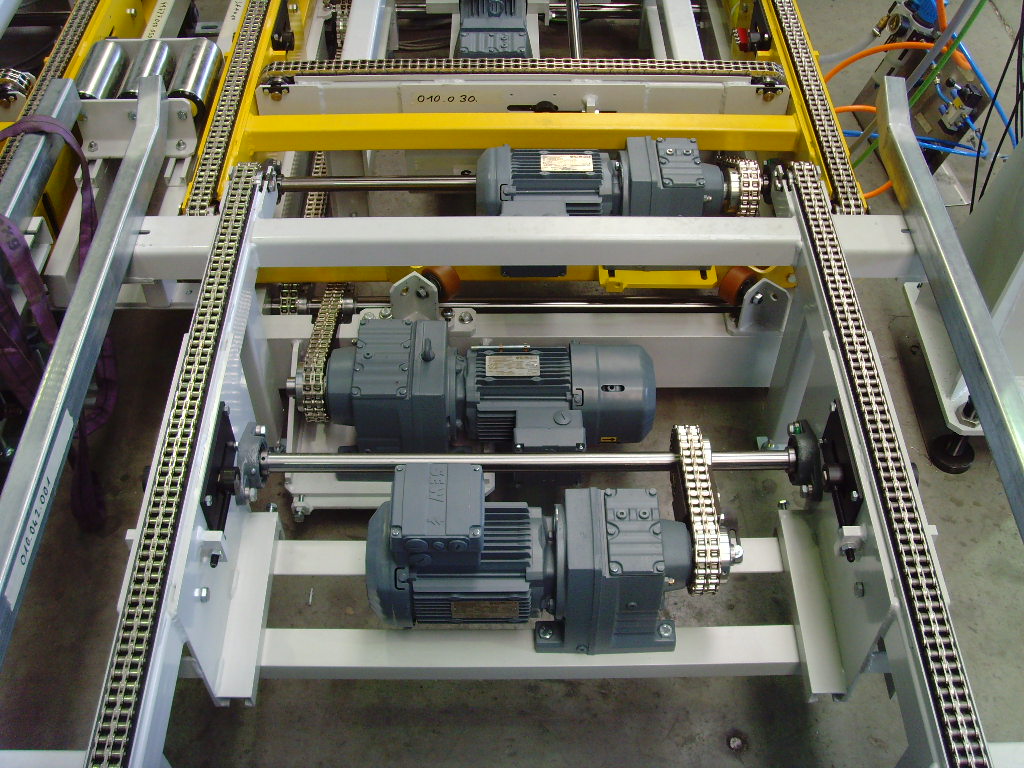
The basic design is the same across all types. A steel frame carries the loads. At one end sits the drive station with geared motor and sprocket, at the other the return station. Between them the chain runs on guide rails, carrying on the upper strand and returning on the lower one.
Depending on the application, the guide rails are made of plastic or steel. Plastic runs quieter and with less friction, steel withstands higher temperatures and abrasive material. A tensioning device at the return station compensates for the elongation every chain undergoes in service. If it is not adjusted, the chain will eventually jump the sprocket.
Types
The simplest form is the single-strand chain conveyor. The material rests on one chain, usually with flights. That is enough for narrow parts and light loads.
More common is the twin-strand chain conveyor, where two parallel chains pick up the load at its outer edges. This is how pallets, mesh boxes and workpiece carriers are moved without supporting the contact surface in the middle.
With hinged-plate and modular belt chains, the links themselves form a continuous surface. This is the type for small parts, bottles and containers, and with stainless steel or plastic links also the one for food production, because it can be cleaned.
For bulk material there are drag chain and scraper conveyors. Here the chain pulls the material through an enclosed trough. This type also conveys on an incline and dust-tight, but wears faster.
When flights are needed
Flights are cross bars or angles mounted on the chain that carry the material by positive engagement. Without them only the friction between chain and load transmits the movement, and that is enough only on horizontal runs with smooth operation.
As soon as the run inclines, material is to be accumulated, or a defined position at the next station is needed, there is no way around flights. Their spacing sets the cycle, because it determines how many parts leave the line per minute. This is the point where a conveying line becomes hard to change later, because the spacing is built into the chain pitch.
Advantages
Chain conveyors take high individual loads, because the force is transmitted through chain tension rather than friction. They work at temperatures where a rubber belt gives up, and they tolerate swarf, oil, weld spatter and sharp edges. Their position is precisely defined by the flights, which makes connecting them to cycled processing stations straightforward.
There is also serviceability. A damaged chain is repaired link by link, whereas a torn belt is usually replaced in full.
Limits and drawbacks
Chain conveyors are louder than belt conveyors, particularly with steel chains on steel rails. They need maintenance: retensioning, lubrication, checking wear on sprockets and wear strips. Without lubrication the friction coefficient rises, and with it the drive power required.
The type is unsuitable for delicate or very small parts, because material can slip between the links. And it costs more to buy than a comparable roller or belt conveyor, which only evens out over its service life.
What determines the sizing
It starts with the chain tension. It is made up of the friction force that material and chain generate on the wear rails, plus the lifting force on inclined runs. The friction force depends on the weight of the material, the dead weight of the chain over the full length and the friction coefficient of the rail pairing.
Drive power follows from the tension and the conveying speed, divided by the efficiency of the gearbox. The calculated force must stay below the permissible breaking load of the chain, usually with a clear margin, because starting torque and accumulation briefly go well above it.
Two figures are regularly underestimated. First the dead weight of the chain: over long runs it exceeds the weight of the material. Second accumulation. If the chain keeps running under stationary material, friction rises considerably, and the sizing has to cover that condition, not normal operation.
What belongs in an enquiry
For a sizing to hold up you need the weight and dimensions of the heaviest item, the conveying length and incline, the required cycle time or speed, the ambient conditions such as temperature, moisture and dust, and whether accumulation is needed. Knowing which stations the line connects to and at what transfer height saves a full round of clarification.
Do you have a concrete project?
Talk to our engineering team. An initial conversation is non-binding and quickly creates clarity.